Axolotl
The Old AxolotlThe Axolotl is a resurrected animal and one of the novel’s most persistent images of unfinished life. Revived by Vincent Cho for Project Genesis, it inhabits the same laboratories that are rebuilding life on an immense scale; in Bartek’s dreams, it becomes a voter, a spectator, a fleeing figure, and finally an image fused with a mech’s head. Its recurrence connects biological survival to the story’s questions about transformation, redundancy, and whether changing one’s form can produce a meaningful difference.
Identity and Revival
The Axolotl is identified by its scientific name, Ambystoma mexicanum, and described as a larva that persists as a water monster. It fills terrariums at MIT and Bartek’s dreams alike: a real creature in the laboratories of Project Genesis, but also an image that crosses into the novel’s surreal and emotional landscapes.
Its place in the revival program reflects the uneven record left by pre-Extermination science. Species that had not seemed endangered were often not precisely documented or archived, because there had been no urgent reason to preserve them. Species already extinct posed a different problem: researchers lacked the base material needed for revival. The most viable candidates were therefore animals that had been approaching extinction before the Extermination. For these species, scientists had preserved both a DNA package and complete epigenetic recipes. The Axolotl was among them, a creature already on the fast track to extinction and thus unusually recoverable by the new science of resurrection.
That history makes the Axolotl more than an example of Project Genesis’s technical achievement. Its return depends on the preservation of both inherited material and the recorded conditions for its expression. Against the broad ambition to synthesize and breed new forms of life, this small amphibian carries the specific history of a species nearly lost before the catastrophe—and of a science whose archives were shaped by earlier judgments about what needed saving.
The creature in Bartek’s dreams
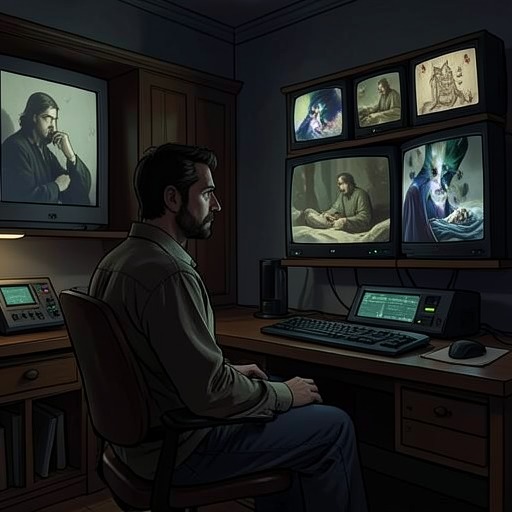
The Axolotl’s most elaborate appearance comes in a dream that Bartek experiences through Morpheus. At one-third scale, the animals he has flushed from a terrarium assemble on the lawn as a parliament, ready to vote on the laws of life and metal. Bartek attacks them with the fragile Lily mech’s lasers, firing from its eyes and fingernails. The amphibians become black-and-white figures, like cutouts from an exotic fairy tale. The scene gives the Axolotls a collective civic role, only to turn them into images under the mech’s fire: participants in a debate about life and machinery, and material for Bartek’s surreal dream at once.
The dream then changes scale and mood. Night falls; strange constellations fill the sky; Frances Rory glows beneath black cobras, and her emotes take the form of thin-steel origami, sharp as a thicket of blades. Against this world of transformation and dangerous beauty, the parliamentary Axolotls belong to a dream in which forms can be refashioned but not made reassuring. Their formal assembly suggests order, while their conversion into stark cutouts strips that order of any stable authority.
In another exchange, Bartek calls the Axolotl an entire life form produced for no purpose, the result of an evolutionary impulse whose supposed larval transition has become an ending in itself. He treats its adult life as redundant and asks why such a creature exists. The question is voiced within his account of a dream he calls the true history of mankind, not presented as a scientific conclusion. The Axolotl’s peculiar development becomes his way of imagining a world in which a transitional form persists without arriving at a higher purpose. The image reaches beyond the animal: Bartek’s unease concerns existence that seems to continue without explaining why it should.
Witness to conflict and transformation
The Axolotl also appears when Bartek discusses the possibility of sending a living person into orbit. As he turns away from the dream, he desynchronizes and fixes his attention on the coupling ring between two balloons. A spotted Axolotl crawls out of the shadow beneath it and glares at the two Horuses. Its sudden, concrete arrival interrupts the technological discussion without resolving it. Bartek argues that the humanos established California and must therefore be learning something; the question of whether to put a live person in a rocket remains open. The animal is a silent presence at the point where speculation about life beyond Earth meets the bodily risk of sending a person there.
During the vast mech fight, Axolotls appear again as spectators. The Al-Asr tears cables from the Schmitt’s chest; the Schmitt tears a two-ton section from a tower and clubs its opponent with it. The combat expands in the Mothernet across sinking aircraft carriers, alien continents, and exploding supernovas, with the mechs striking at impossible scale. Around them, wide-eyed Axolotls gorge themselves on popcorn. The image is grotesque and comic, placing small animals as an audience for violence that has become spectacle. Yet when Bartek later picks up the Schmitt 4’s arm, weathered by a year and a half of desert wind and sand, the scene turns inward: he cannot move, and something in him breaks that is explicitly not hardware. The Axolotls’ popcorn-eating spectatorship is set against the grief the battered machine remains capable of feeling.
From emblem to final image
The Axolotl becomes a sharply personal image when Bartek responds to Lady Spiro’s appeal that she and her children like him and will miss him. His derisive emote shows an Axolotl fleeing a syringe filled with hormones. It condenses his resistance into a single picture: an animal escaping an intervention that would alter it. The image sits beside his complaint that Lady Spiro’s children have allowed themselves to be vectored without saying goodbye, and his fear that they regard him as furniture or an old computer rather than as someone to greet and mourn. In this moment the Axolotl is not simply a symbol of biological oddity; its flight gives bodily form to Bartek’s refusal of the transformation being pressed upon him.
At the edge of the cliff, the head of the Al-Asr changes from a cinnabar-colored egg into the oval snout of an Axolotl. Its bulging eyes, described as those of an amphibian frozen in development, look out over the continent of death and dreaming. This is not a return to the animal as a separate creature: the image has entered the mech’s body, blending animal form and machine. The frozen-development quality repeats the earlier concern with a larval state that does not resolve into something else, while the view across the continent enlarges that condition into a vision of Bartek’s world.
Bartek finally rises at dusk and limps away from the gates of First Paradise toward the lights of San Francisco. His body has lost its roundness and smoothness; after a hundred steps, his right forearm falls off. The Golden Gate Bridge stands over the desert like a trampoline for the full moon, and Axolotls, bored with life, leap from it into a river of stones. Their last appearance joins the creature’s earlier associations with unfinished development and threatened survival to an act of departure. The animals do not explain Bartek’s choice, but their leap accompanies his own movement away from the Paradise he cannot remain in.
Narrative significance
Across these appearances, the Axolotl shifts among several roles without settling into a single allegorical meaning. It is a species recovered from the brink of extinction, an absurd object of Bartek’s philosophical disgust, a participant in dream politics, a spectator at mechanized war, and an image embedded in the Al-Asr. Its recurrence links biological life to mechanical existence without making them identical: the animal can be bred and restored, while the mech bears damage, grief, and the pressure of decisions about transformation.
The creature’s suspended life stage gives these connections their force. The Axolotl becomes an emblem of persistence without guaranteed progress: a form that survives, but whose survival does not answer the question of purpose. At the same time, its physical appearances resist remaining a mere abstraction. It crawls from a shadow, watches the Horuses, crowds the Genesis terrariums, and leaps from the bridge. The novel lets the Axolotl carry Bartek’s doubts about change, but keeps returning it to the material world as an animal with a presence beyond his interpretation.